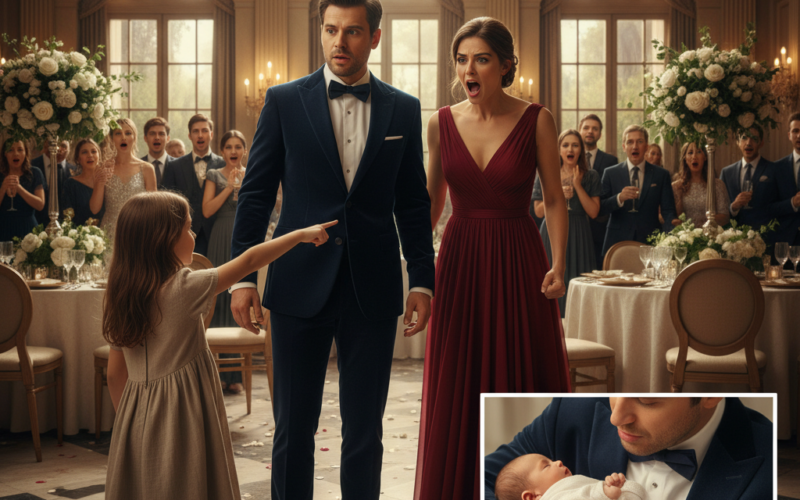
In the gilded halls of a high-end ballroom, where crystal chandeliers cast warm light over silk-draped tables and champagne glasses, a wedding celebration was about to become something else entirely. What should have been Elena and Marko’s perfect evening transformed into a moment of reckoning when the smallest guest in the room delivered the most explosive revelation of the night.
The Accusation That Stopped Time
The scene unfolded with the precision of a carefully orchestrated drama, yet carried the raw authenticity of truth finally breaking free. Seven-year-old Mia, dressed simply in beige linen while surrounded by guests in formal attire, walked deliberately to the center of the opulent ballroom. Her small frame seemed dwarfed by the grandeur around her—towering floral arrangements, gleaming marble floors, and the weight of two hundred wedding guests’ expectations.
But Mia carried something more powerful than the room’s luxury: knowledge that had been buried too long. With the unwavering certainty that only children possess, she extended her arm toward the groom and delivered words that would echo long after the last guest departed: “It’s him. He’s the one who left the baby at the door.”
The ballroom, moments before filled with gentle conversation and clinking glasses, fell into a silence so complete it seemed to absorb even the ambient hum of the chandeliers.
The Bride’s World Crumbles
Elena’s reaction was immediate and visceral. The woman who had spent months planning every detail of this evening—from the sequined bodice of her dark red gown to the precise arrangement of white roses on each table—suddenly found herself staring at a stranger wearing her fiancé’s face. Her eyes widened with the kind of disbelief that comes not from surprise, but from the horrible recognition that pieces of a puzzle are finally, devastatingly, clicking into place.
“Liar! I have never seen you like this!” The words tore from her throat with a rawness that cut through the ballroom’s refined atmosphere. Here was a woman confronting not just betrayal, but the realization that the man she was about to marry had been living a lie so profound it involved an abandoned child.
The contrast was striking: Elena in her carefully chosen gown, hair perfectly styled, makeup flawless for what was supposed to be the most photographed day of her life, now facing a truth that made all those preparations seem like elaborate stage dressing for a performance that was never real.
The Groom’s Silent Confession
Marko’s response spoke volumes in its restraint. Rather than immediate denial or outrage, he held a small bundle wrapped in white blanket—a detail that suggested this confrontation had been building toward this moment for some time. His examination of a mark on the baby’s hand was performed with the careful attention of someone confirming what he already suspected.
“That wasn’t my baby. Tell me the truth,” he whispered, but his words carried the weight of a man who knew he was asking for confirmation of something that would destroy multiple lives. The navy velvet of his tuxedo, chosen to complement Elena’s gown in their wedding photos, now seemed like a costume he was ready to shed.
The baby in his arms represented more than an abandoned child—it was physical evidence of decisions made in desperation, of consequences that couldn’t be hidden forever, of the way past actions have a way of demanding acknowledgment at the most inconvenient times.
The Ripple Effect Through the Room
The wedding guests, frozen in their formal poses around decorated tables, became unwilling witnesses to a family drama that would reshape their understanding of everyone involved. These were people who had come to celebrate love, who had chosen gifts from registries and planned their outfits around a joyous occasion. Instead, they found themselves observing the real-time destruction of carefully constructed lives.
The ballroom’s opulent setting—designed to showcase happiness and prosperity—now served as a stark backdrop to human frailty and the consequences of hidden truths. The very grandeur that was meant to elevate the celebration now seemed to mock the intimate devastation playing out at its center.
When Children Become Truth-Tellers
Mia’s role in this revelation highlights something profound about children as witnesses to adult secrets. At seven, she possessed the moral clarity that adults often compromise away. Her simple linen dress among the formal wear, her barefoot honesty in a room full of carefully constructed presentations, represented authenticity in a space that had become defined by deception.
Children see what adults choose to ignore. They remember what adults hope will be forgotten. In this case, Mia carried knowledge that the adults in her life had decided was too dangerous to acknowledge—until the moment when staying silent became impossible.
The Mark That Changed Everything
The detail of Marko examining a birthmark or identifying mark on the baby’s hand suggests a deeper story about identity, parentage, and the ways DNA and distinctive features can serve as undeniable evidence when words fail. This wasn’t just about an abandoned baby—it was about biological truth asserting itself despite attempts to obscure it.
That small mark represented the kind of evidence that can’t be argued away, explained differently, or dismissed as misunderstanding. It was proof that demanded acknowledgment, forcing all three adults into a moment of reckoning they had been avoiding.
This wedding reception became a powerful reminder that truth has its own timeline, often emerging at moments when we’re least prepared to handle it. The luxury ballroom setting, the formal attire, the carefully planned celebration—none of it could protect against the simple honesty of a child who knew what she had witnessed. As guests stood in stunned silence, three lives were forever changed by the intersection of past decisions and present consequences. What do you think drives children to speak truths that adults choose to bury? And how do we navigate the aftermath when those truths finally surface?