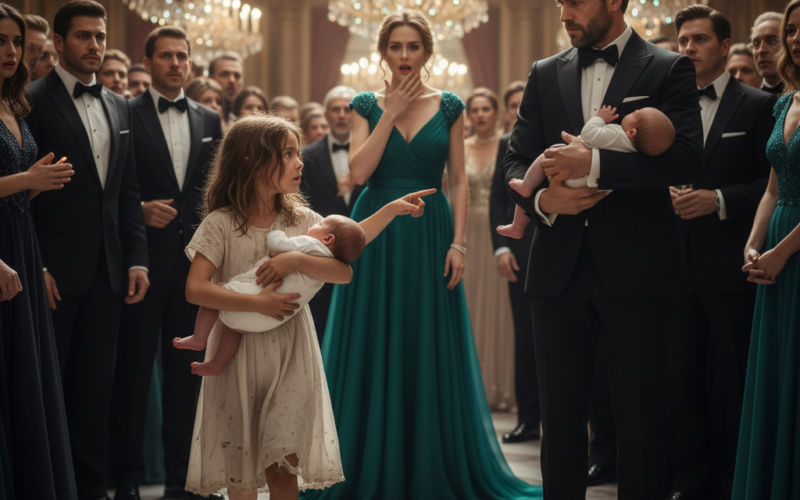
The crystal chandeliers cast their warm glow over another glittering charity gala, where champagne flutes clinked and designer gowns swept across marble floors. But this evening’s festivities would be remembered for something far more dramatic than fundraising totals. When a barefoot child carrying an infant walked through the crowd of shocked socialites, her simple words would shatter the carefully constructed world of high society’s most respected figures.
The Unlikely Witness Steps Forward
Maya appears like a specter from another world, her small bare feet padding silently across the polished ballroom floor. The contrast couldn’t be more stark—her simple beige cotton tunic and disheveled appearance cutting through a sea of black-tie elegance like a knife through silk. The guests, resplendent in their evening wear, part before her with expressions of confusion and growing alarm.
Clutched against her chest is a baby, wrapped in what appears to be a hastily grabbed blanket. Maya’s long hair falls in tangles around her face, but her eyes burn with a determination that seems far beyond her eight years. This is not a lost child seeking help—this is someone on a mission, carrying a burden that has driven her to interrupt the most exclusive social event of the season.
The ambient sounds of the gala—the gentle murmur of conversation, the soft clink of crystal, the rustle of expensive fabric—gradually fade as more guests notice the unusual intrusion. The warm chandelier light that moments before created an atmosphere of luxury now illuminates what appears to be an unfolding crisis.
The Accusation That Changes Everything
“It is her. She left the baby in the cold, I saw everything.” Maya’s words ring out with startling clarity, her small finger pointing directly at Elena, a vision of sophistication in her emerald green sequined gown. The accusation cuts through the refined atmosphere like a thunderclap, leaving guests frozen in shocked silence.
Elena’s reaction is immediate and explosive. Her carefully styled blonde updo trembles as she gestures wildly, her polished composure cracking under the weight of the child’s words. “Stop this madness, I have never even seen her before in my life!” The desperation in her voice betrays something deeper than mere indignation—there’s fear lurking beneath her fury.
The ballroom has become a stage for this impromptu drama, with hundreds of witnesses watching as a child challenges one of society’s most respected figures. Maya’s bare feet and simple clothing stand in stark contrast to Elena’s designer gown and jeweled accessories, yet in this moment, the power dynamic has completely shifted.
A Father’s Growing Suspicion
Julian, distinguished in his deep blue velvet tuxedo, takes the baby from Maya’s arms with the careful movements of someone familiar with handling infants. His strong jawline tightens as he examines the child, and something he sees—perhaps in the baby’s features, or a telltale mark on the tiny hand—causes his expression to transform from confusion to cold realization.
The athletic build that serves him well in business negotiations now seems coiled with tension as he processes what Maya has revealed. His short dark hair remains perfectly styled, but his face tells the story of a man whose world is suddenly shifting beneath his feet. The warm chandelier light catches the hard set of his features as understanding dawns.
When Julian finally speaks, his voice carries the weight of someone who has connected devastating dots. “Give me the honest truth now.” The words are measured, controlled, but they land with the force of an ultimatum. This is no longer a child’s wild accusation—this is a man demanding accountability from someone he trusted.
The Unraveling of Perfect Lives
What makes this confrontation so compelling isn’t just the dramatic accusation, but what it reveals about the carefully constructed facades that define high society. Elena’s emerald gown and elegant updo represent hours of preparation for this gala, yet they cannot protect her from a child’s simple truth. The intricate lace details and sequined perfection that once commanded admiration now seem like elaborate armor that has failed in its most crucial test.
The guests surrounding them represent a world where reputation is everything, where charitable galas and social standing matter more than inconvenient truths. Yet here stands Maya, barefoot and unpolished, wielding nothing but her eyewitness testimony to challenge this entire system.
Julian’s transformation from confused bystander to stern interrogator suggests this isn’t the first time Elena’s actions have raised questions. His immediate shift to demanding truth implies a history of suspicions that Maya’s accusation has finally brought to light.
The Power of Speaking Truth to Privilege
This scene resonates because it captures something universal about courage and accountability. Maya, despite her youth and obvious disadvantage, refuses to let injustice hide behind wealth and social position. Her willingness to walk barefoot into this intimidating environment, carrying physical evidence of what she witnessed, speaks to a moral courage that many adults struggle to find.
The baby she carries isn’t just an infant—it’s living proof of consequences that someone tried to abandon. Maya’s decision to bring the child directly to the source of the problem, rather than seeking help through official channels, suggests either a sophisticated understanding of how power protects itself, or simply the instinctive knowledge that sometimes direct confrontation is the only path to justice.
Elena’s vehement denial, complete with wild gesturing and claims of never having seen Maya before, follows a predictable pattern of deflection. Yet the specificity of Maya’s accusation—that she “saw everything”—suggests this child has witnessed something that goes beyond mere suspicion or hearsay.
In an era where wealth and status often shield individuals from consequences, Maya’s brave confrontation serves as a powerful reminder that truth has a way of surfacing, regardless of how deeply it’s buried beneath privilege and pretense. Her barefoot march into that glittering ballroom represents every moment when ordinary people must find the courage to challenge those in power. What would you do if you witnessed something terrible and knew that speaking up meant facing down society’s most protected figures? Share your thoughts on how we can better support those brave enough to speak truth to power.