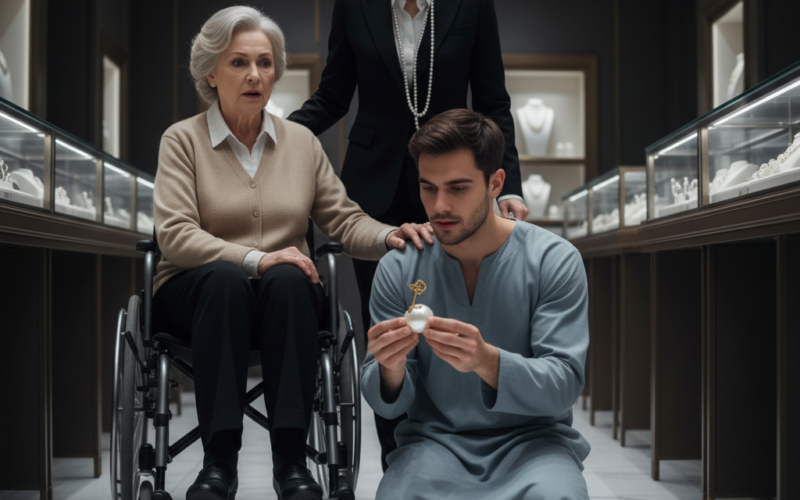
In the sterile elegance of an upscale jewelry boutique, three generations collide in a moment that exposes the brutal reality of family business dynamics. What begins as an aggressive confrontation over pearls quickly transforms into something far more consequential—the discovery of a hidden key that could topple an empire.
The Violent Revelation
The scene unfolds with shocking suddenness in the pristine environment of a high-end jewelry store. Elena, a dignified 70-year-old matriarch confined to a wheelchair, sits surrounded by the glittering displays of wealth that have defined her family’s legacy. Her daughter Victoria, sharp-suited and radiating corporate aggression, towers over her with barely contained fury.
The violence is swift and calculated. Victoria’s hand moves with practiced precision, swiping across Elena’s neck to snap the pearl necklace—a gesture that speaks to years of accumulated resentment and power struggles. The pearls scatter across the white marble floor like scattered hopes, their gentle rolling sound a stark contrast to the tension crackling between mother and daughter.
Victoria’s words cut through the boutique’s refined atmosphere: “Don’t try to play games with me.” This isn’t a daughter speaking to her mother—this is a corporate predator asserting dominance over a perceived threat.
The Trembling Hands of Discovery
Marcus, the young assistant caught between these warring titans, represents the collateral damage of family warfare. His light blue uniform marks him as service staff, but his position in this drama runs deeper than mere employment. As he kneels to gather the scattered pearls, his shaking hands betray the weight of whatever knowledge he carries.
The moment Marcus pries open the large pearl reveals the story’s true stakes. Hidden within the lustrous exterior lies a tiny gold key—small enough to conceal, significant enough to change everything. This isn’t merely jewelry; it’s a carefully constructed insurance policy, a failsafe that Elena has carried close to her heart for who knows how long.
The physical act of cracking open the pearl becomes symbolic of exposing family secrets that were meant to stay buried. Marcus’s careful manipulation of the pearl suggests this isn’t his first encounter with Elena’s hidden strategies.
The Vault and the Execution
Victoria’s reaction to the key’s discovery transforms the entire dynamic. Her jaw drops, her composure shatters, and suddenly she’s no longer the aggressor but the vulnerable one. Her whispered confession—”A key to the vault… my husband would consider this an execution”—reveals layers of corporate intrigue and marital politics.
This vault represents more than stored wealth; it’s the nerve center of whatever empire Victoria and her husband have built. The key’s existence suggests Elena has maintained access to information or resources that could destroy everything her daughter has worked to create. The mention of execution isn’t hyperbole—in the ruthless world of high-stakes business, such betrayals often carry deadly consequences.
Victoria’s fear exposes the precarious nature of her position. Despite her aggressive posturing, she’s trapped between her mother’s machinations and her husband’s expectations, a corporate middle manager masquerading as a power player.
The Soul of the Company
Elena’s final words carry the weight of prophecy and warning. Her calm placement of a hand on Marcus’s arm—a gesture of benediction—marks the formal transfer of power from one generation to another, bypassing Victoria entirely. “If the company ever becomes too obsessed with the future to empathize with a person, give this to the one who still has a soul.”
This statement reveals Elena’s deeper concern: that in the pursuit of profit and progress, her family’s business has lost its humanity. The key isn’t just about access to physical assets—it’s about preserving the moral center of an organization that has drifted toward ruthless pragmatism.
By entrusting the key to Marcus rather than Victoria, Elena makes a devastating judgment about her own daughter’s character. Victoria has become exactly what Elena fears most: a corporate entity without empathy, someone who would rip pearls from an elderly woman’s neck without hesitation.
The Weight of Choice
Marcus now carries more than a key—he holds the future of a company and the moral responsibility Elena has placed upon him. His demographic position as a young Southeast Asian man in a predominantly white, wealthy family structure adds additional complexity to his role as moral arbiter.
The boutique setting amplifies the story’s themes of surface beauty hiding deeper truths. Like the pearls themselves, which conceal secrets within their lustrous shells, the family’s polished exterior masks generations of accumulated grievances and moral compromises.
The sterile, expensive environment reflects the emotional distance that wealth and power have created within this family. Even in a space designed to showcase beauty and luxury, violence and betrayal feel perfectly at home.
This confrontation in a jewelry boutique becomes a microcosm of corporate family dynamics where love, loyalty, and survival intersect with devastating consequences. Elena’s strategic thinking, Victoria’s desperate aggression, and Marcus’s reluctant involvement create a triangle of competing interests that will reshape their relationships forever. The question remains: will Marcus use the key to preserve Elena’s vision of empathetic leadership, or will the corrupting influence of power ultimately claim another soul? What do you think drives families to such extremes when business and blood collide?