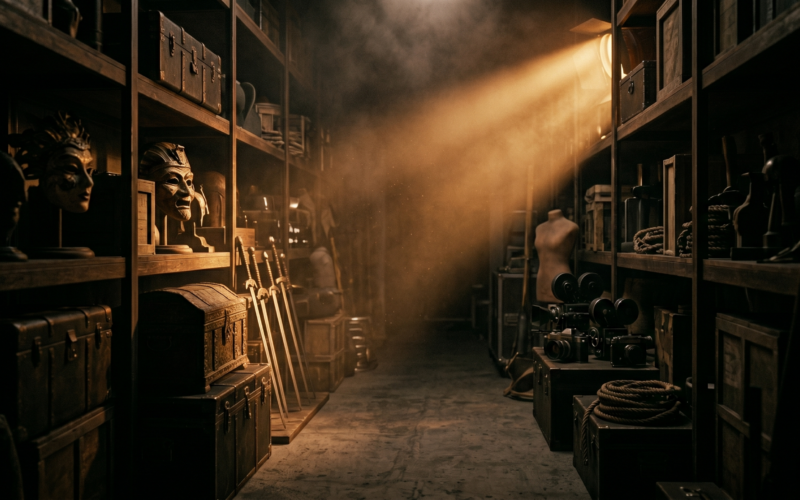
That iconic sword, that magic ring, that beat-up car — where do they go when the movie wraps? The afterlife of movie props is a world of vaults, auctions, collectors, and the occasional dumpster.
Every film is built from thousands of physical objects: weapons, costumes, vehicles, gadgets, and set pieces. Some become as famous as the actors who held them. But when the cameras stop and the set is struck, those objects don’t just vanish. They begin a second life that can be surprisingly dramatic — ending up in a studio vault, a museum, a private collection, a charity auction, or, sometimes, a landfill. Here’s what really happens to movie props once the movie is done.
First stop: the prop house and the studio archive
Most major productions don’t actually own every object outright. A large share of props, especially generic ones, are rented from specialized prop houses — vast warehouses stocked with everything from antique telephones to fake weapons to period furniture. When filming wraps, these rented items simply go back to the warehouse to be used again in another production. That lamp in your favorite drama might also appear in a sitcom and a horror film, quietly working across dozens of projects.
Hero props — the special, screen-defining objects custom-made for a specific film — are a different story. These are often retained by the studio, catalogued, and stored in climate-controlled archives. Big studios maintain enormous archives precisely because these items have historical and commercial value, and because they may be needed again for sequels, reshoots, or promotional displays.
Multiples: there’s never just one
Here’s a behind-the-scenes truth that surprises most people: for any important prop, there usually isn’t a single object — there are many. Productions routinely create multiples of a hero prop for practical reasons. There might be a pristine “hero” version for close-ups, a lightweight rubber “stunt” version for action scenes, a backup in case of damage, and several more besides.
This is why, when a famous prop comes up for auction, you’ll sometimes see multiple “authentic” versions surface over the years — each one genuinely used during production, just for different purposes. It’s not fraud; it’s simply how filmmaking works.
The auction afterlife
Some of the most famous props in film history have ended up on the auction block, where they can sell for staggering sums. Movie memorabilia has become a serious collector’s market, with iconic costumes, vehicles, and objects fetching anywhere from thousands to millions of dollars depending on their fame and screen time.
The value is driven by the same forces that drive any collectible: rarity, condition, cultural significance, and provenance — the documented proof that the item was actually used on screen. A prop with airtight provenance, ideally with studio paperwork and on-screen matching, commands a premium. Auction houses that specialize in entertainment memorabilia have built entire businesses around verifying and selling these pieces.
When props go to museums
Not every famous prop is sold. Many of the most significant objects in film history end up in museums and traveling exhibitions, where fans can see them up close. Dedicated film and pop-culture museums, studio tours, and touring exhibitions allow studios to share their history with the public — and to keep their most valuable artifacts protected and insured rather than scattered.
For studios, lending iconic props to exhibitions is also smart business: it keeps beloved films in the public consciousness and reinforces the brand long after a movie’s theatrical run has ended.
The ones that get lost — or thrown away
For every prop lovingly preserved in a vault, there are countless others that simply disappear. In the earlier decades of Hollywood, props and costumes were frequently seen as disposable production materials rather than future treasures. Items were reused until they fell apart, given away, or thrown out entirely. Many objects that would be worth fortunes today were lost simply because no one at the time imagined anyone would care.
Even now, with greater awareness of memorabilia value, things slip through the cracks. Props get damaged, misplaced during studio moves, or quietly discarded when storage space runs short. Collectors and archivists sometimes spend years tracking down objects that were thought to be lost forever.
The crew keepsakes
There’s also a long, semi-official tradition of cast and crew taking home small props or pieces of the set as mementos when a production wraps. A coffee mug, a background trinket, a piece of a costume — these keepsakes are usually minor, but occasionally an item that walked off set in someone’s bag decades ago resurfaces and turns out to be historically significant. Productions today are generally stricter about what can leave the set, precisely because of how valuable these objects can become.
Why we care so much about objects
There’s something deeply human about our fascination with movie props. A prop is a tangible link between the fictional world we love and our own reality — proof that the magic was, in some small way, real. Holding (or even just seeing) the actual object that appeared on screen collapses the distance between audience and story in a way that nothing else quite does.
That’s why collectors pay fortunes, why museums build exhibits, and why fans line up to glimpse a famous costume behind glass. The prop isn’t just a piece of painted foam or molded plastic. It’s a physical piece of a story that meant something to millions of people.
So the next time you spot an unforgettable object in a film, remember: somewhere out there, that exact thing (or one of its several twins) still exists — sitting in a vault, a display case, a collector’s home, or, just maybe, forgotten in someone’s attic, waiting to be rediscovered.
Curious about more film-world secrets? Read our story on how the Hollywood Walk of Fame really works.