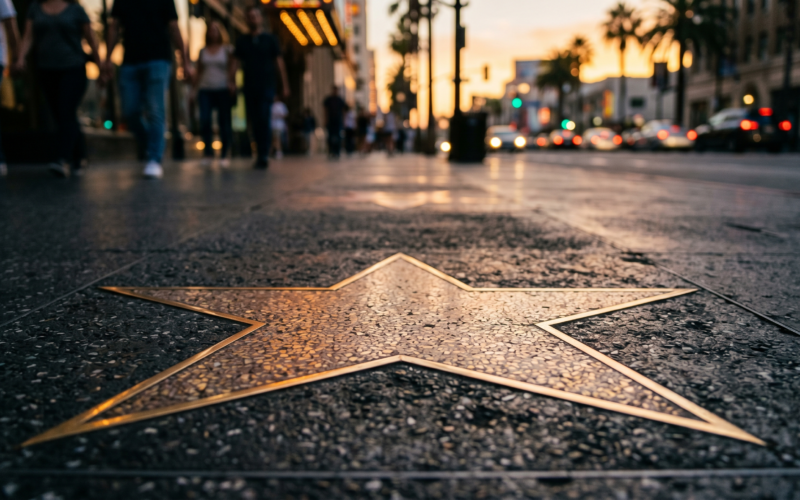
Think a star on the Walk of Fame is a free honor handed out to famous people? The truth involves applications, committees, a five-figure fee — and celebrities who flat-out refused.
Stretching for more than a mile along Hollywood Boulevard and Vine Street, the Hollywood Walk of Fame is one of the most visited landmarks in Los Angeles, drawing millions of tourists every year. More than 2,700 brass-and-terrazzo stars are embedded in its sidewalks. But ask most people how a celebrity actually gets one, and you’ll hear the same wrong answer: “They give it to you when you’re famous enough.”
Not quite. Here’s how it really works.
Someone has to nominate you — and you have to say yes
Stars don’t appear automatically, no matter how famous you are. Every star begins with a nomination submitted to the Hollywood Chamber of Commerce, the private organization that has administered the Walk since its creation in the early 1960s. Anyone can technically submit a nomination — a fan club, a studio, a record label, a manager — but there’s a crucial catch: the celebrity (or their representative) must agree to the nomination in writing.
That’s right. Nobody gets a star against their will. The honoree also has to commit to personally attending the unveiling ceremony, which is why you’ll never see a star dedicated to someone who didn’t show up for it (posthumous stars, awarded under special rules, are the exception).
A committee decides — and most nominations are rejected
Each year, the Walk of Fame Selection Committee reviews the pool of nominations — typically a couple hundred — and selects only around 20 to 30 honorees. The committee weighs factors like professional achievement, longevity in the industry (generally five years or more), charitable contributions, and the likelihood that the celebrity will actually attend the ceremony.
Stars are awarded in five categories, each marked by its own emblem on the star: Motion Pictures (a film camera), Television (a TV set), Recording (a record), Radio (a microphone), and Live Performance (theater masks). Some legends hold stars in multiple categories — Gene Autry is famously the only person with a star in all five.
The part nobody talks about: the fee
Here’s the detail that surprises most people. A Walk of Fame star comes with a sponsorship fee in the tens of thousands of dollars — in recent years, around $75,000 or more. The money doesn’t come out of the celebrity’s pocket in most cases; it’s typically paid by a studio, record label, fan organization, or other sponsor, often timed to promote a new movie or album. The fee covers the creation and installation of the star, the ceremony itself, and contributes to the ongoing maintenance of the Walk.
That’s also why star ceremonies so often coincide suspiciously well with a big release. A star unveiling is, among other things, a world-class publicity event — complete with press coverage, celebrity speeches, and a guaranteed spot on the entertainment news cycle.
The A-listers who said no
Given the application process, you might wonder why some of the biggest names in entertainment don’t have stars. The answer is usually simple: they declined or never agreed to a nomination.
George Clooney, Julia Roberts, Denzel Washington, and Bruce Springsteen are among the major names long absent from the Walk. Clint Eastwood — one of the most decorated figures in Hollywood history — reportedly never arranged a ceremony despite being selected decades ago. For some celebrities, the publicity-driven nature of the process holds little appeal; others simply never had a sponsor put them forward at the right moment.
Strange and surprising stars
The Walk has its share of oddities. There are stars for fictional characters and non-humans, including Mickey Mouse, Bugs Bunny, Kermit the Frog, Godzilla, and the dog Lassie. The Apollo 11 astronauts received special round “moon” plaques on the corners of Hollywood and Vine. Muhammad Ali’s star is unique in another way — at his request, it was mounted on a wall at the Dolby Theatre rather than on the ground, because he didn’t want the name he shared with the Prophet Muhammad to be walked on.
And yes, stars can be a magnet for controversy. Vandalized stars have been repaired multiple times over the years — Donald Trump’s star, for instance, was famously destroyed with a pickaxe on more than one occasion — but the Chamber’s longstanding policy is that stars are considered permanent fixtures and historic landmarks, and are not removed.
Who takes care of all those stars?
The terrazzo stars take a beating from millions of footsteps, weather, and the occasional film shoot. The Hollywood Historic Trust, a nonprofit, oversees restoration and repair, funded in part by those sponsorship fees. Damaged stars are repaired or recreated, and the entire Walk has undergone major restoration projects over the decades to keep it tourist-ready.
So is it an honor or a marketing tool?
Honestly — it’s both, and it always has been. The Walk of Fame was conceived in the 1950s partly as a way to glamorize Hollywood Boulevard and draw visitors to the neighborhood, and it has succeeded beyond anyone’s dreams. For the celebrities, a star is a genuine career milestone, a photo-op, and a piece of permanent real estate in entertainment history, all at once.
The next time you’re walking down Hollywood Boulevard reading names underfoot, remember: every single one of those stars represents an application, a committee vote, a five-figure check, and a celebrity who said, “Yes, I’ll be there.”
Want more behind-the-scenes Hollywood stories? Read our piece on the iconic movie roles that almost went to completely different actors.